

Sometimes an author speaks in such a gentle, quiet way that you almost lean in to listen deeply. Khalil Gibran has that strong effect. If you first met him through The Prophet or stumbled on one of the most famous Khalil Gibran Quotes during a difficult moment, you know that his words settle in the mind and stay there. I myself keep on returning to his sentences because they don’t just only wisdom; they feel like deep yet realistic conversations we were already having with ourselves. But just didn’t know how to complete.
So in this post, I’m going to explore 150+ Khalil Gibran’s quotes (the famous ones and not so famous ones) that will help you find a moment of relief, ease, and happiness in this cruel world.
Before moving on to Khalil Gibran Quotes, let’s learn a bit about the poet:
Who Was Khalil Gibran?
Kahlil Gibran (1883-1931) was a Lebanese-American poet, writer, and artist, renowned for his philosophical and spiritual works, most famously The Prophet, a best-selling book consisting of many prose poems about life, death, and love, making him a seminal figure in modern Arabic and American literature. With his romantic and mystical style, Gibran bridges Eastern and Western thought.

What was Khalil Gibran Famous for?
The Prophet is Kahlil Gibran’s most notable work, published by Alfred A. Knopf in 1923. This is the book that made him famous. The book consists of 26 prose poems, and upon its debut release, it sold over 1,100 of the 2,000 copies.
Khalil Gibran’s Writing Style and Philosophy
When it comes to Khalil Gibran’s writing style, he employs a mystical, poetic, and spiritual language. He explains complex ideas about different topics, such as love and death, in clear and simple language that is accessible to everyday people. This, in turn, urges the reader to reflect and mend their ways. He also employs imagery, especially nature imagery, to translate abstract concepts. Moreover, his writings mirror a spiritual tone.
Gibran’s philosophy is to blend Eastern mysticism with Western ideas of individualism. This way, he changed the course of Arabic poetry by introducing themes such as spirituality, existentialism, and personal freedom.
Khalil Gibran Quotes in The Prophet (1923)
The Prophet is Khalil Gibran’s most celebrated work and one of my all-time favourite books. It is structured as a series of poetic pieces delivered by Almustafa, a spiritual teacher who is leaving the city of Orphalese after twelve years. Before his final departure, the people of the city ask him to speak on different aspects of human life, ranging from love, joy, sorrow, death, and marriage to work, freedom, and children. Instead of offering a strict set of moral rules, Gibran portrays life as a spiritual path where each stop gives wisdom resulting from self-knowledge, experience, and compassion.
If you ask me, what is the message of The Prophet by Kahlil Gibran?
I’d say that the book’s central message is that the true meaning of life is discovered through conscious living, an intimate connection between the human soul with each other and the divine, and inner freedom.
Core Themes
The main themes that you’ll find in this book are:
- Spiritual wisdom
- Human relationships
- Self-discovery
- Love and Marriage
- Religion and the soul (SEO: Khalil Gibran religion)
- Sorrow and Healing
- Parenting
Khalil Gibran Quotes in The Prophet
The following are Khalil Gibran quotes:
- “Your children are not your children. They are the sons and daughters of Life’s longing for itself.”
- “They come through you but not from you, And though they are with you yet they belong not to you.”
- “You may give them your love but not your thoughts, For they have their own thoughts.”
- “You are the bows from which your children as living arrows are sent forth.”
- “Love one another, but make not a bond of love: Let it rather be a moving sea between the shores of your souls.”
- “Love gives naught but itself and takes naught but from itself. Love possesses not nor would it be possessed; For love is sufficient unto love.”
- “And think not you can direct the course of love, for love, if it finds you worthy, directs your course.”
- “Let there be spaces in your togetherness, And let the winds of the heavens dance between you.”
- “The deeper that sorrow carves into your being, the more joy you can contain.”
- “Your pain is the breaking of the shell that encloses your understanding.”
- “Much of your pain is self-chosen. It is the bitter potion by which the physician within you heals your sick self.”
- “Work is love made visible.”
- “And if you cannot work with love but only with distaste, it is better that you should leave your work and sit at the gate of the temple and take alms of those who work with joy.”
- “You talk when you cease to be at peace with your thoughts.”
- “Let there be spaces in your togetherness, And let the winds of the heavens dance between you. Love one another but make not a bond of love: Let it rather be a moving sea between the shores of your souls. Fill each other’s cup but drink not from one cup. Give one another of your bread but eat not from the same loaf. Sing and dance together and be joyous, but let each one of you be alone, Even as the strings of a lute are alone though they quiver with the same music. Give your hearts, but not into each other’s keeping. For only the hand of Life can contain your hearts. And stand together, yet not too near together: For the pillars of the temple stand apart, And the oak tree and the cypress grow not in each other’s shadow.”
- “Love possesses not nor would it be possessed; For love is sufficient unto love. And think not you can direct the course of love, if it finds you worthy, directs your course. Love has no other desire but to fulfil itself.”
- “But if you love and must needs have desires, let these be your desires: To melt and be like a running brook that sings its melody to the night. To know the pain of too much tenderness. To be wounded by your own understanding of love; And to bleed willingly and joyfully.”
- “The timeless in you is aware of life’s timelessness. And knows that yesterday is but today’s memory and tomorrow is today’s dream.”
- “Some of you say, “Joy is greater than sorrow,” and others say, “Nay, sorrow is the greater.”
But I say unto you, they are inseparable.
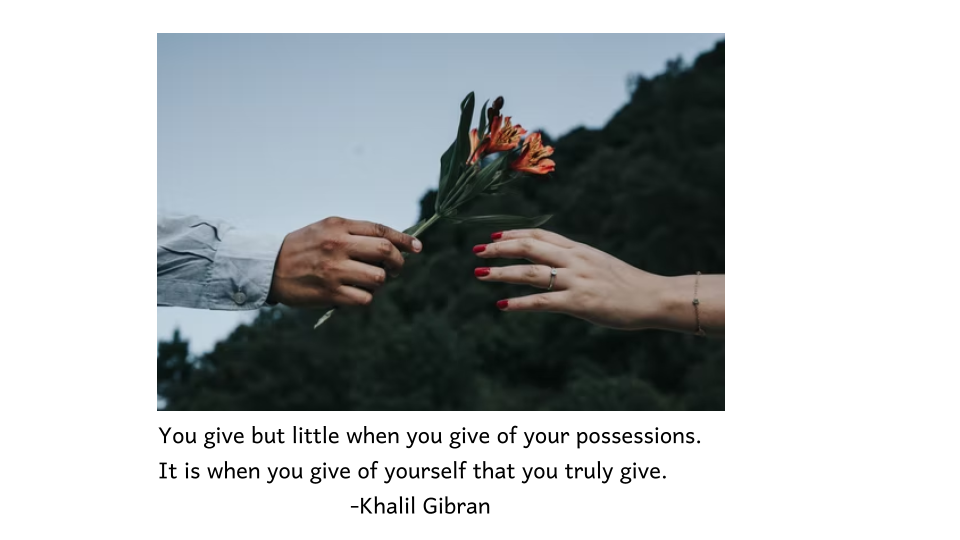
Together they come, and when one sits alone with you at your board, remember that the other is asleep upon your bed.” - “You give but little when you give of your possessions.
It is when you give of yourself that you truly give.” - “To belittle, you have to be little.”
- “Love knows not its own depth until the hour of separation.”
- “Your pain is the breaking of the shell that encloses your understanding.”
- “To measure you by your smallest deed is to reckon the power of the ocean by the frailty of its foam.”
- “To judge you by your failures is to cast blame upon the seasons for their inconstancy.”
- “Say not, “I have found the truth,” but rather, “I have found a truth.”
- “For what is evil but good tortured by its own hunger and thirst?”
- “And think not you can direct the course of love, for love, if it finds you worthy, directs your course.”
- “Much of your pain is self-chosen.”
- “The deeper that sorrow carves into your being, the more joy you can contain.”
- “What is fear of need but need itself?”
- “The breath of life is in the sunlight and the hand of life is in the wind.”
- “If you cannot but weep when your soul summons you to prayer, she should spur you again and yet again, though weeping, until you shall come laughing.”
- “These things he said in words. But much in his heart remained unsaid. For he himself could not speak his deeper secret.”
- “And is not the lute that soothes your spirit the very wood that was hollowed with knives?”
- “For even as love crowns you so shall he crucify you. Even as he is for your growth so is he for your pruning.
- “Long were the days of pain I have spent within its walls, and long were the nights of aloneness; and who can depart from his pain and his aloneness without regret?”
- “Joy and sorrow are inseparable, together they came and where one sits alone with you at the board remember that the other is asleep upon your bed.”
- “Your friend is your needs answered.
When you part from your friend, you grieve not;
For that which you love most in him may be clearer in his absence, as the mountain to the climber is clearer from the plain.” - “And if our hands should meet in another dream, we shall build another tower in the sky.”
- “What is word knowledge but a shadow of wordless knowledge?”
- “It is well to give when asked, but it is better to give unasked through understanding.”
- “For in truth it is life that gives unto life-while you, who deem yourself a giver, are but a witness.”
- “It is not a garment I cast off this day, but a skin that I tear with my own hands.”
- “Shall the day of parting be the day of gathering?
And shall it be said that my eve was in truth my dawn?” - “Let not the waves of the sea separate us now, and the years you have spent in our midst become a memory.”
- “Sing and dance together and be joyous, but let each one of you be alone.
Even as the strings of a lute are alone though they quiver with the same music.” - “For what is prayer but the expansion of your self into the living ether?”
- “Is not the cup that holds your wine the very cup that was burned in the potter’s oven?”
- “And there are those who have little and give it all.”
Khalil Gibran Quotes in Sand and Foam (1926)
Sand and Foam is a collection of short aphorisms, philosophical reflections, and poetic fragments that unravel Gibran’s mystical worldview in its most distilled form. The book studies themes, such as hope, faith, social justice, suffering, memory, contradiction, and spiritual insight through short, yet paradoxical statements. Instead of telling a continuous story, Gibran invites you to pause, think, and interpret the meaning personally.
What is the book mainly about?
The work mainly focuses on the truth that is multifaceted, wisdom is sometimes hidden in silence, and spiritual comprehension emerges slowly through contemplation and inner awareness.
Core Themes
- Humanity
- Inner vs. outer beauty
- Nature
- Spirituality
- Judgement
Khalil Gibran Quotes in Sand and Foam
Some of the best quotes from Khalil Gibran’s Sand and Foam are:
- “Generosity is giving more than you can, and pride is taking less than you need.”
- “You may forget with whom you laughed, but you will never forget with whom you wept.”
- “They deem me mad because I will not sell my days for gold; and I deem them mad because they think my days have a price.”
- “We live only to discover beauty. All else is a form of waiting”
- “Men who do not forgive women their little faults will never enjoy their great virtues.”
- “I have never agreed with my other self wholly. The truth of the matter seems to lie between us.”
- “If your heart is a volcano, how shall you expect flowers to bloom?”
- “I am forever walking upon these shores,
Betwixt the sand and the foam,
The high tide will erase my foot prints,
And the wind will blow away the foam,
But the sea and the shore will remain forever.” - “You see but your shadow when you turn your back to the sun.”
- “All our words are but crumbs that fall down from the feast of the mind.”
- “Remembrance is a form of meeting.”
- “Trees are poems that the earth writes upon the sky.”
- “Seven times I have despised my soul:
The first time when I saw her being meek that she might attain height.
The second time when I saw her limping before the crippled.
The third time when she was given to choose between the hard and the easy, and she chose the easy.
The fourth time when she committed a wrong, and comforted herself that others also commit wrong.
The fifth time when she forbode for weakness, and attributed her patience to strength.
The sixth time when she despised the ugliness of a face, and knew not that it was one of her own masks.
And the seventh time when she sang a song of praise, and deemed it a virtue.” - “When you reach the end of what you should know, you will be at the beginning of what you should sense.”
- “My loneliness was born when men praised my talkative faults and blamed my silent virtues.”
- “Half of what I say is meaningless; but I say it so that the other half may reach you.”
- “Sadness is but a wall between two gardens.”
- “There is a space between man’s imagination and man’s attainment that may only be traversed by his longing.”
- “When life does not find a singer to sing her heart she produces a philosopher to speak her mind.”
- “Strange, the desire for certain pleasures is a part of my pain.”
- “It was but yesterday I thought myself a fragment quivering without rhythm in the sphere of life. Now I know that I am the sphere, and all life in rhythmic fragments moves within me.”
- “Poetry is a deal of joy and pain and wonder, with a dash of the dictionary.”
- “You may forget the one with whom you have laughed, but never the one with whom you have wept.”
- “You cannot judge any man beyond your knowledge of him, and how small is your knowledge.”
- “Long ago you were a dream in your mother’s sleep, and then she awoke to give you birth.”
- “They dip their pens in our hearts and think they are inspired.”
- “You are blind and I am deaf and dumb, so let us touch hands and understand.”
- “Some of our children are our justifications and some are but our regrets.”
- “It takes two of us to discover truth: one to utter it and one to understand it.”
- “You may judge others only according to your knowledge of yourself.”

Khalil Gibran Quotes in The Madman (1918)
The Madman, His Parables and Poems is an introspective and symbolic collection of parables narrated by a man who becomes “mad” after losing the facades he once wore to satisfy and please society. Through brief, allegorical stories, Gibran investigates freedom, identity, conformity, and the conflict between the individual self and social expectations. Madness in the book also symbolizes liberation instead of illness. In simple words, abandoning social pretenses gives a person permission to live more truthfully and faithfully. The work also challenges readers to question more and manners, adopt self-awareness, and identify how society fears authenticity.
What is the main idea of this book?
This book focuses on celebrating authenticity, liberation, and true selfhood by tearing apart societal masks. It doesn’t matter if it means being seen as an outcast or “mad”.
Core Themes
- Hypocrisy
- Societal pressure
- Individuality
- Freedom
- Spirituality
- Human connection
Khalil Gibran Quotes in The Madman
Below are some notable Khalil Gibran quotes:
- “I have found both freedom and safety in my madness; the freedom of loneliness and the safety from being understood, for those who understand us enslave something in us.”
- “To understand the heart and mind of a person, look not at what he has already achieved, but at what he aspires to.”
- “My friend, I am not what I seem. Seeming is but a garment I wear — a care-woven garment that protects me from thy questionings and thee from my negligence. The “I” in me, my friend, dwells in the house of silence, and therein it shall remain for ever more, unperceived, unapproachable.”
- “Defeat, my defeat, my deathless courage, You and I shall laugh together with the storm, And together we shall dig graves for all that die in us, and we shall stand in the sun with a will, And we shall be dangerous.”
- “A fox looked at his shadow at sunrise and said, “I will have a camel for lunch today.” And all morning he went about looking for camels. But at noon he saw his shadow again-and he said, “A mouse will do.”
- “And when I reached the market place, a youth standing on a house-top cried, “He is a madman.” I looked up to behold him; the sun kissed my own naked face for the first time. For the first time the sun kissed my own naked face and my soul was inflamed with love for the sun, and I wanted my masks no more. And as if in a trance I cried, “Blessed, blessed are the thieves who stole my masks.”
- “I have seen a face whose sheen I could look through to the ugliness beneath, and a face whose sheen I had to lift to see how beautiful it was.”
- “I have seen a face with a thousand countenances, and a face that was but a single countenance as if held in a mould.”
- “Memory is an autumn leaf that murmurs a while in the wind and then is heard no more.”
- “Remember only that I smiled.”
- “Yet you shall not deplore having known blindness, nor regret having been deaf. For in that day you shall know the hidden purposes in all things, And you shall bless darkness as you would bless light.”
- “The joy of scaring is a deep and lasting one, and I never tire of it.”
- “Only those who are stuffed with straw can know it.”
- “I have seen an old face much lined with nothing, and a smooth face in which all things were graven.”
- “The Good God and the Evil God met on the mountain top.The Good God said, “Good day to you, brother.”The Evil God did not answer.And the Good God said, “You are in a bad humour today.”“Yes,” said the Evil God, “for of late I have been often mistaken for you, called by your name, and treated as if I were you, and it ill-pleases me.”And the Good God said, “But I too have been mistaken for you and called by your name.”The Evil God walked away cursing the stupidity of man.”
- “You ask me how I became a madman. It happened thus: One day, long before many gods were born, I woke from a deep sleep and found all my masks were stolen, the seven masks I have fashioned and worn in seven lives, I ran maskless through the crowded streets shouting, “Thieves, thieves, the cursed thieves.” Men and women laughed at me and some ran to their houses in fear of me.”
- “When I am silent, I have thunder hidden inside.”
- “I would rather be a superb meteor, every atom of me in magnificent glow, than a sleepy and permanent planet.”
- “The eye of a human being is a microscope, which makes the world seem bigger than it really is.”
- “I existed from all eternity and, behold, I am here; and I shall exist till the end of time, for my being has no end.”
- “My God, my aim and my fulfillment; I am thy yesterday and thou are my tomorrow. I am they root in the earth and thou art my flower in the sky, and together we grow before the face of the sun.”
- “I heard the bellow of beasts and the hunger of the forest. And I heard the cry of lonely men, and the plaint of those who long for what they know not.
I heard the sighing of the maiden for her lover, and the panting of the luckless hunter for his prey. And then there came peace into their music, and the heavens and the earth sang together. All this I saw in my dream, and all this I heard.” - “I go — as others already crucified have gone. And think not we are weary of crucifixion. For we must be crucified by larger and yet larger men, between greater earths and greater heavens.”
- “Defeat, my defeat, my deathless courage, You and I shall laugh together with the storm, And together we shall dig graves for all that die in us, and we shall stand in the sun with a will, And we shall be dangerous.”
- “I know faces, because I look through the fabric my own eye weaves, and behold the reality beneath.”
- “Why dispute what we shall be, when we know not even what we are.”
- “And when I descended to the valleys and the plains God was there also.”
- “The ‘I’ in me, my friend, dwells in the house of silence, and therein it shall remain for ever more, unperceived, unapproachable.”
- “The joy of scaring is a deep and lasting one, and I never tire of it.”
- “But my mother did not understand, nor did the nurse; for the language I spoke was that of the world from which I came.”
Khalil Gibran Quotes in The Broken Wings (1912)
The Broken Wings is a semi-autobiographical novella that narrates a tragic love story set in early twentieth-century Beirut in first-person narration. The narrative follows a young man’s contagious and deep emotional bond with Selma Karamy, a woman trapped by patriarchal authority, societal constraints, and religious corruption. It is the strict traditions and power structures that crush their love, resulting in disillusionment and loss. Through this intimate, tragic story, Gibran critiques social injustice and stereotypes and explores the pain of unfulfilled love. He further reflects on how we sacrifice personal liberation in the name of control and custom.
What is the point of The Broken Wings?
The main point of the book is to portray love as superior to what we think and perceive. Societal and cultural stereotypes cage the boundless nature of love into a limited one.
Core Themes
The main themes in this book are:
- Nature
- Spiritual connection
- Patriarchy
- Beauty
- Love
- Womanhood and spirituality
- Suffering and perseverance
Khalil Gibran Quotes in The Broken Wings
The best Khalil Gibran quotes are:
- “Solitude has soft, silky hands, but with strong fingers it grasps the heart and makes it ache with sorrow.”
- “The appearance of things changes according to the emotions; and thus we see magic and beauty in them, while the magic and beauty are really in ourselves.”
- “And God said “Love Your Enemy,” and I obeyed him and loved myself.”
- “Modern civilization has made woman a little wiser, but it has increased her suffering because of man’s covetousness. The woman of yesterday was a happy wife, but the woman of today is a miserable mistress.”
- In the past she walked blindly in the light, but now she walks open-eyed in the dark. She was beautiful in her ignorance, virtuous in her simplicity, and strong in her weakness. Today she has become ugly in her ingenuity, superficial and heartless in her knowledge.”
- “Will the day ever come when beauty and knowledge, ingenuity and virtue, and weakness of body and strength of spirit will be united in a woman?”
- “Love is the only freedom in the world because it so elevates the spirit that the laws of humanity and the phenomena of nature do not alter its course.”
- “Love provided me with a tongue and tears.”
- “Extreme torture is mute, and so we sat silent, petrified, like columns of marble buried under the sand of an earthquake. Neither wished to listen to the other because our heart-threads had become weak and even breathing would have broken them.”
- “The gardens were full of Nisan flowers and the earth was carpeted with green grass, and like a secret of earth revealed to Heaven.”
- “She was the one who first sang to me the poetry of real life.”
- “…where days pass like dreams and nights like weddings.”
- “There is something greater and purer than what the mouth utters. Silence illuminates our souls, whispers to our hearts, and brings them together. Silence separates us from ourselves, makes us sail the firmament of spirit, and brings us closer to Heaven; it makes us feel that bodies are no more than prisons and that this world is only a place of exile.”
- “Selma was deeply thoughtful rather than talkative, and her silence was a kind of music that carried one to a world of dreams and made him listen to the throbbing of his heart, and see the ghosts of his thoughts and feelings standing before him, looking him in the eyes.”
- “Solitude is the ally of sorrow as well as a companion of spiritual exaltation.”
- “He said, “I do not know any other man in Beirut whose wealth has made him kind and whose kindness has made him wealthy. He is one of the few who come to this world and leave it without harming any one, but people of that kind are usually miserable and oppressed because they are not clever enough to save themselves from the crookedness of others.”
- “Unless a person is born again his life will remain like a blank sheet in the book of existence.”
- “That sorrow which obsessed me during my youth was not caused by lack of amusement, because I could have had it; neither from lack of friends, because I could have found them.”
- ” Is not silence more painful than death?”
- “He who has not been bitten by the serpents of light and snapped at by the wolves of darkness will always be deceived by the days and the nights.”
- “Be happy because I shall live in you after my death.”
- “This is the only friend I shall have after you are gone, but how can he console me when he is suffering also? How can a broken heart find consolation in a disappointed soul? A sorrowful woman cannot be comforted by her neighbour’s sorrow, nor can a bird fly with broken wings.”
- “It is hard to write down in words the memories of those hours when I met Selma −−those heavenly hours, filled with pain, happiness, sorrow, hope, and misery.”
- “A bird with broken wings cannot fly in the spacious sky.”
- “He was born like a thought and died like a sigh and disappeared like a shadow.”
- “His life began at the end of the night and ended at the beginning of the day.”
- “The poets and writers are trying to understand the reality of woman, but up to this day they have not understood the hidden secret of her heart because they look upon her from behind the sexual veil and see nothing but the externals: they look upon her through a magnifying glass of hatefulness and find nothing except weakness and submission.”
- “Every beauty and greatness in this world is created by a single thought or emotion inside a man. Every thing we see today, made by past generation, was, before its appearance, a thought in the mind of a man or an impulse in the heart of a woman.”
- “Love that comes between the naivete and awakening of youth satisfies itself with possessing, and grows with embraces. But Love which is born in the firmament’s lap and has descended with the night’s secrets is not contented with anything but eternity and immortality.”
- “My life was a coma, empty like that of Adam’s in Paradise, when I saw Selma standing before me like a column of light. She was the Eve of my heart who filled it with secrets and wonders and made me understand the meaning of life…”
- “Materially, he was like earth, and hard like steel. And greedy like a grave.”
- “The flowers of the field are the children of sun’s affection and nature’s love; and the children of men are the flowers of love and compassion…”
- “He was born at dawn and died at sunrise…”
- “It was my first discovery of the fact that men, even if they are born free, will remain slaves of strict laws enacted by their fore-fathers; and that the firmament, which we imagine as unchanging, is the yielding of today to the will of tomorrow and submission of yesterday to the will of today-“
- “Many a time, since that night, I have thought of the spiritual law which made Selma prefer death to life, and many a time I have made a comparison between nobility of sacrifice and happiness of rebel-lion to find out which one is nobler and more beau-tiful; but until now I have distilled only one truth out of the whole matter, and this truth is sincerity, which makes all our deeds beautiful and honorable. And this sincerity was in Selma Karamy.”
- “A bird with broken wing cannot fly in the spacious sky. The eyes that are accustomed to the dim light of a candle are not strong enough to stare at the sun. Do not talk to me of happiness; its memory makes me suffer.”
- “My desires so that you may live freely and virtuously. Limited love asks for possession of the beloved, but the unlimited asks only for itself.”
- “Limited love asks for possession of the beloved, but the unlimited asks only for itself.”
- “Love that comes between the naivete and awakening of youth satisfies itself with possessing, and grows with embraces. But Love which is born in the firmament’s lap and has descended with the night’s secrets is not contented with anything but Eternity and immor-tality; it does not stand reverently before anything except deity.”
- “Did God give us the breath of life to place it under death’s feet?”
- “Did He give us liberty to make it a shadow for slavery?”
- “He who does not rebel against oppres-sion is doing himself injustice.”
- “I love you, Selma, and you love me, too; and Love is a precious treas-ure, it is God’s gift to sensitive and great spirits.”
- “But my dear readers, don’t you think that such a woman is like a nation that is oppressed by priests and rulers? Don’t you believe that thwarted love which leads a woman to the grave is like the despair which pervades the people of the earth? A woman is to a nation as light is to a lamp. Will not the light be dim if the oil in the lamp is low?”
- “EVERYTHING THAT a man does secretly in the darkness of night will be dearly revealed in daylight. Words uttered in pri-vacy will become unexpectedly common conversa-tion. Deeds which we hide today in the corners of our lodgings will be shouted on every street to-morrow.”
- “I stood lonely aside without a soul to console me, as if Selma and her child meant nothing to me.”
- “The farewell-bidders left the cemetery; the grave digger stood by the new grave holding a shovel with his hand.”
- “Do you re member where Farris Effandi Karamy was buried?” He looked at me for a moment, then pointed at Selma’s grave and said, “Right here; I ‘placed his daughter upon him and upon his daughter’s breast rests her child, and upon all I put the earth back with this shovel.” Then I said, “In this ditch you have also buried my heart.”
- “As the grave digger disappeared behind the pop-lar trees, I could not resist any more; 1 dropped down on Selma’s grave and wept…”
- “I love you as a mother loves her only child, and Love only taught me to protett you even from myself. It is Love, purified with fire, that stops me from following you to the farthest land. Love kills my desires so that you may live freely and virtuously.”
 If you enjoyed the best Khalil Gibran Quotes, you will also enjoy: 100+ Existentialism Quotes You Should Know: Definition, Theory, and Wisdom From Sartre, Camus, Nietzsche, Beauvoir & More