


The Descend into Digital Middle Ages…
The other day, I was looking at the photo of a renowned celebrity who had undergone a weight loss journey. From being a plus-size to a zero figure, they attracted attention and online scrutiny. Then, a plethora of comments:
“They look so healthy!”
“They seem to be so happy!”
“Hot!”
“They were pretty before!”
“They ate!”
“Wonders of Ozempic!”
It is the last comment that confused me, to be honest. I didn’t know what Ozempic is! So, I searched it up. Turns out, it is an anti-diabetic medicine now used for weight loss. There were many others that are also currently used by people to get rid of fat.
From that moment, I started seeing many posts related to how people underwent a weight loss journey. The results were impressive, and the consequences were shocking!
Some stories were enough to convince a person not try it. Yet many did, and many do…
This made me wonder, why is it that so?
We look at our phones, scroll through faces perfected by filters, and read headlines about the latest “miracle” weight-loss needle, Ozempic. We tell ourselves we are living in the peak of modern freedom. We can be anything, say anything, and look like anyone.
But are we really free? Or have we just digitized our chains?
I am sure I am not the only one who has these questions, and yet here we are!
I think that the truth is, the pressure to shrink, to edit our waists with an app or an injection, to conceal and paint out our “flaws” until we look like dolls (and generic ones), isn’t new. It’s ancient and very much there from the beginning.
If you strip away the Wi-Fi and the electricity and the wonders of AI, you’ll find that we are re-living the same obsession and standards with perfection that defined the most notorious era in English history.
Welcome to the Middle Ages!
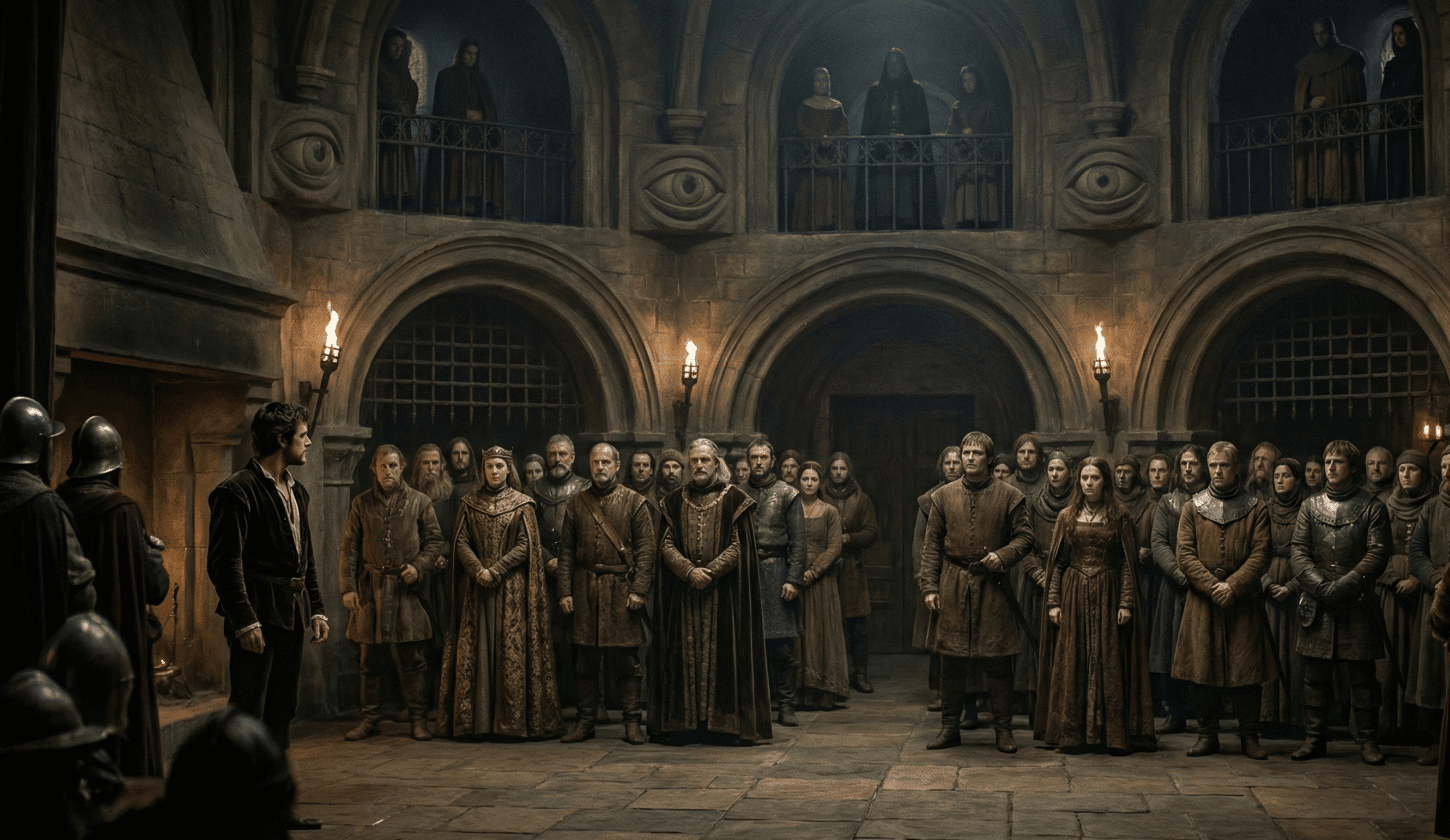
The Middle Ages or Medieval Period: The 1,000-Year Waiting Room (500 AD – 1500 AD)
Technically, the Medieval Ages are the historical period in Europe lasting from the 5th to the late 15th century. It started with the fall of the Western Roman Empire and ended with the Renaissance and the Age of Discovery.
Historians typically divide it into three ages:
-
The Early Middle Ages (The chaotic start)
-
The High Middle Ages (The rise of population and castles)
-
The Late Middle Ages (The time of plagues and famine)
If you look, then the “Middle Ages” is just the label historians slapped on the long stretch of time between the fall of Rome and the start of the Renaissance. But definitions are boring. So, let’s talk about the vibe.
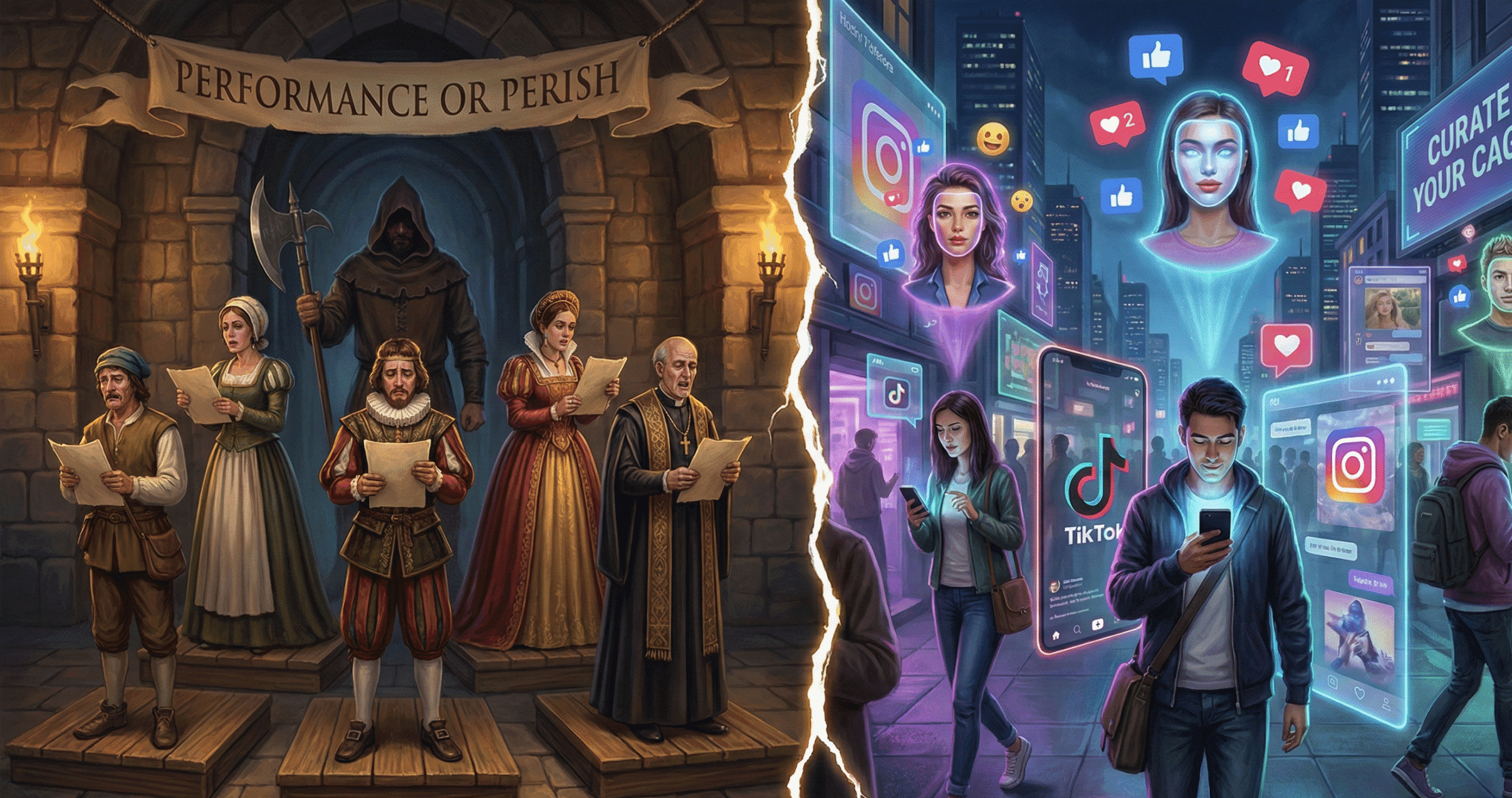
Picture a world that operated like a very strict, very high-stakes theater production. Everyone had a script, and they had to learn it by heart. Everyone had a costume that was supposed to be a part of their life.
And if you messed up your lines or changed your clothes?
You weren’t just made embarrassed or mocked. You were simply exiled or executed.
This was an era defined by a suffocating set of mores and manners. It is obvious that it wasn’t a time to “be yourself.” It was a time to be who you were told to be.
Now look at the world you are living in!
Although we believe we can be anything, the box of questions remains open:
If we can be anything, then why is everyone trying to be something they are not?
When did the idea of being free become synonymous with fitting into something else?
When did not following trends become similar to not following a script in the Middle Ages?
How did we choose the safe cloak of “I, too, am updated” over the risk of being myself?
The Performance of Perfection
In the medieval world, life was a constant performance.
The men: If you were a man (especially) of status, you couldn’t just be a guy who likes to do whatever he wants. You had to be a walking Swiss Army Knife of “Chivalry.” You had to be brave and bold enough to kill, but sensitive and artistic enough to write poetry. You had to know how to sing, how to dance, and exactly how many degrees to bow when a lady entered the room.
It was demanding…It was exhausting…Most importantly, it was inhumane and unjust… It was the original “Hustle Culture, “always on, always performing.
The women: And what about the women? The requirements were even stricter and more unjust. A “perfect” medieval woman, or shall I say a lady, was expected to be as thin as a willow wand.
She was expected to be very “modest,” covered under a blanket of emotions and clothes, never too loud, never too expressive or bold, and definitely never too angry. Her voice was supposed to be as low as a whisper and as melodious as a bird.
She ran the household like a leader, played the harp like a seasoned artist, and accepted a patriarchal world with a polite, frozen smile.
1st Parallel Between The Middle Ages and Modern Society
In this digital middle age, men are also following a book. Masculinity is increasingly defined and curated by algorithmic rewards: visibility, virality, approval, and belonging. What is rewarded gets repeated and eternalized. What is ignored disappears (no matter how good it is).
So yes, many men today are not simply being. They are curating masculinity.
Some of them perform dominant roles: the updated knight, armored in confidence and certainty. While others learn the precise choreography of passivity, gentleness, and sensitivity. These are not opposing ends of freedom but sanctioned extremes, equally legible and equally rewarded. Like the medieval predecessors, men today are and feel safest when they are readable. And so masculinity and chivalry, once bound to crown and church, are now bound to our screens: rehearsed, repeated, optimized, and endlessly performed.
The Gods of algorithm have turned real man into a collage: having so many faces yet to live a real one.
And when we are looking at the “Ozempic Face” or the “Trad Wife” trend on TikTok or Instagram today, we are looking at the ghost of those medieval women. We are no longer told that our value lies in how we look. Then why is everyone (both men and women) going under the knife?
The journalist Jia Tolentino calls it “Instagram Face:” a single, cyborgian face that prevails our feeds.
So, maybe the culprit is again …
The Gatekeepers of Truth
And you know the scariest part of the Middle Ages wasn’t the wars or plagues; it was the silence.
The Church controlled everything. They decided what was true, what was moral, what was to be followed, and what was law. And here’s the thing, the Bible and the laws were written in a language the common people didn’t speak, nor could they learn easily, Latin.
Imagine that!
The rules for the salvation of your soul were written in a code you couldn’t read.
What if you had questions?
Very dangerous.
Objections?
Too bad.
You had to trust the “experts” blindly.
This is why Geoffrey Chaucer is considered a rockstar. When he wrote The Canterbury Tales, he did something punk-rock: he wrote in English. He wrote in the language of the commons, the farmers, and the real people. He broke the code for the good.
2nd Parallel Between The Medieval Ages and Today’s Society
We look back at those peasants and pity them. We think, How could they let the Church control their reality? Why didn’t they just get together and free themselves?
But look at us now. Phew!
Today, we have traded the Priest for the Programmer. We have swapped Latin for Code.
I mean, think about it. The forces that control your daily life, such as the algorithms that decide what news you see and how much, what items you buy, and even who you date, are written in a language 99% of us do not speak, let alone understand. We don’t comprehend how the Instagram or TikTok feed really works. We don’t know why Google showed us this result and not that one. We just trust the “Black Box” like the peasant trusted the “experts”.
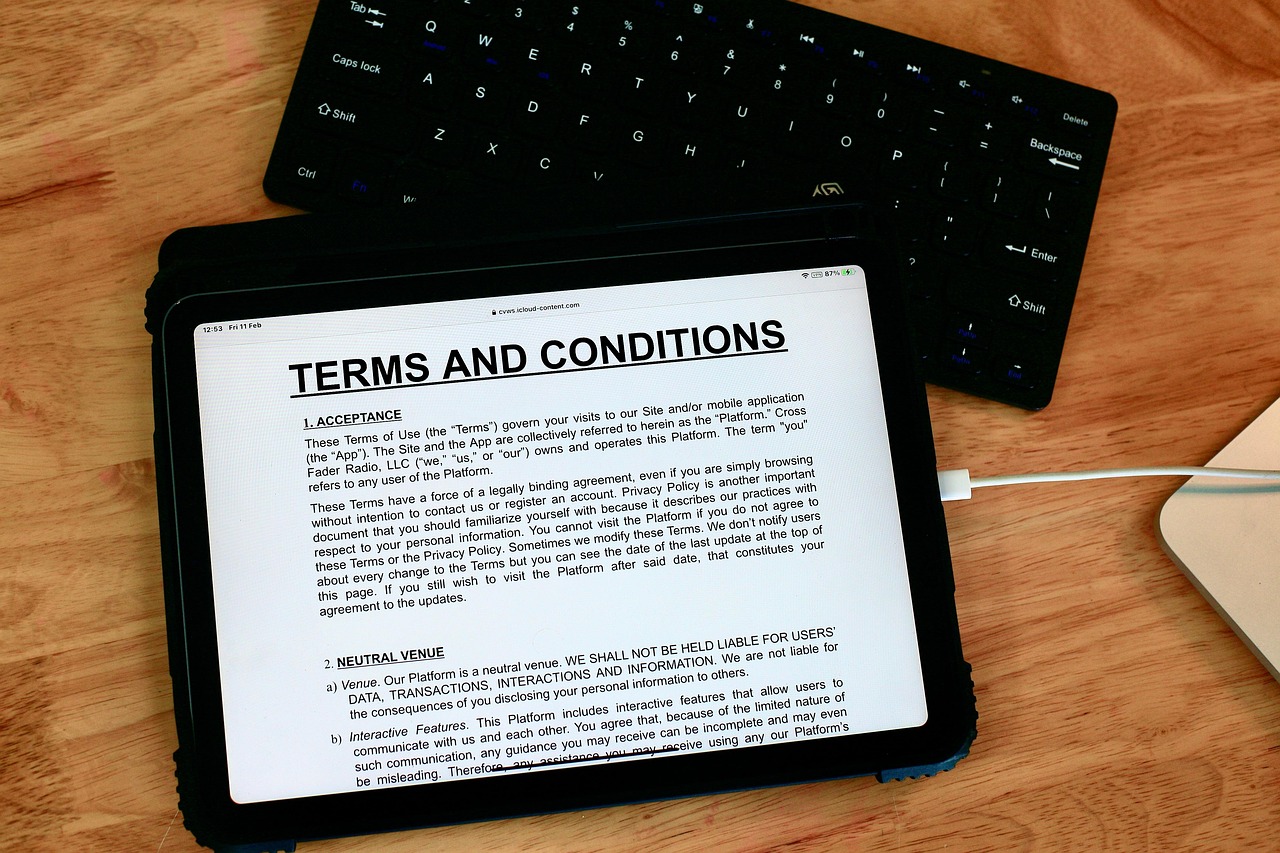
And those “Terms and Conditions” we scroll past?
That is our very modern scripture. We blindly click “I Agree” without reading much (and sometimes reading at all), surrendering our privacy and our data just to be allowed into the big digital village.
The Middle Ages didn’t end because we invented electricity.
The pattern is exactly the same: a small (elite) group speaks the language of power (Code/Data), and the rest of us are just living in their world, thinking we are free.
Who is going to be our modern Chaucer?
Where is the person who will translate the Code back into a common language so we can finally understand the rules of the game we are taking part in?
The “Modern Indulgence” and Buying Moral Purity
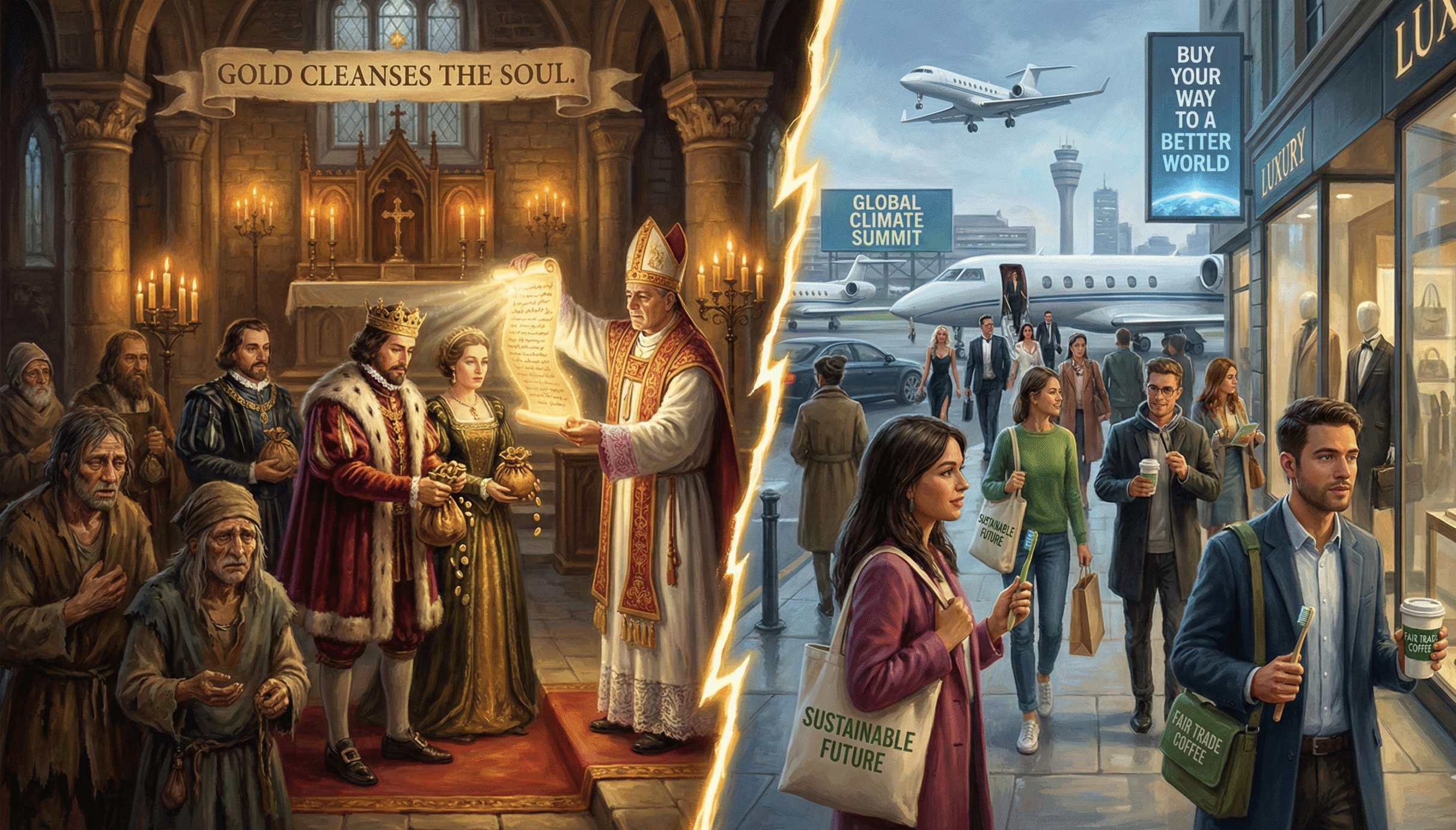
In the Medieval times, the Catholic Church used to sell “Indulgences.” If you sinned (lied, stole, or cheated), you didn’t necessarily have to change your conduct. You could only pay the Church a fee, obtain a piece of paper, and your soul was cleansed thoroughly. The rich could easily afford to be “good,” while the poor stayed “sinners.”
3rd Parallel Between The Medieval and Digital Middle Ages
Today, we do the same. We buy our way out of guilt.
What if we feel bad about this planet?
We don’t stop consuming; we buy a tote bag that says “Sustainable.” Or we purchase a bamboo toothbrush to save our planet.
And what if we feel bad about labor rights?
We purchase “Fair Trade” coffee (even if the system is still very, very broken).
Celebrities fly private jets to climate conferences, Ironic but very much the ultimate modern Indulgence.
From Town Square to Timeline, The Crowd Still Gathers
Likewise, when someone committed a social crime that was unforgivable (or they were poor), cells were not the end of the story. The criminals were locked in a wooden frame in the town square. Their punishment was visibility. The townspeople would throw rotten fruit and laugh at them. The pain was physical. And more than that, it was the total destruction of dignity.
4th Parallel Between the Middle Ages and Today’s Society
When it comes to the Town Square Part. X is the global Town Square. When someone tweets the wrong thing or talks at the wrong time, we don’t just disagree or ignore. We Quote-Tweet them (put them in the stocks). We invite thousands and maybe millions of strangers to throw “digital rotten fruit” at them. And mock them. We also ruin their careers, social lives, and dox their families. We treat shaming as a sport, just like the medieval crowd cheering at an execution.
And irony is that we think that we are civilized because we stopped public executions. But we didn’t stop them. We just moved them online. Our human urge to gather in a circle and watch someone’s life be mocked at or destroyed is still our favorite pastime!
The Alchemists vs. The Biohackers (The Fear of Death)
We laugh at medieval Alchemists for trying to alter lead into gold or “Elixirs of Life” to live eternally. We believe they were superstitious fools.
5th Parallel Between the Middle Ages and the Digital Middle Ages
Look at Silicon Valley!
Nowadays, billionaires are the new Alchemists. They are interfering with young blood (plasma exchange), taking many pills a morning, and sleeping in hyperbaric chambers to cure death. We have just renamed it to “Biohacking” or “Longevity Science,” but the emotional root and cause are very much the same
See, the methods have changed faces, but the refusal to accept that we are mortal and will remain so stays exactly the same.

Why This Matters Now
Because all of this is not history; it is instruction.
When we fail to see the patterns, we mistake performance for freedom and obedience for free will. We start to optimize ourselves instead of understanding and improving ourselves. Bodies and feelings become projects, identities become brands and choices, and dissent becomes dangerous through erasure.
All of it matters because a society that cannot identify its scripts will keep mistaking control for culture. And until we know how to read the system informing us, we will keep calling compliance progress and prosperity.