


Do you feel yourself drowning in the web of complicated ideas and thoughts instead of focusing on one? Do you find it challenging to brainstorm the best ideas or execute a plan? Because I do! If this is the case with you as well, Mind Mapping can be the cure for your productivity failure.
What lies ahead is the opportunity to learn how this tool works.
We will familiarize ourselves with this invaluable tool to organize our thoughts, fashion ideas, and problem-solving, to enhance productivity levels.
But before that, what is this thing called mind mapping?
What is Mind Mapping?
In plain words, mind mapping is a visual playground for your brain. Instead of writing a linear numbered list (1, 2, 3…), a mind map takes root in the center and then explodes outward, just like a tree or firework. It mimics how your mind naturally thinks, by making connections and links, and not by following a set, straight line. Eventually, a non-linear and interconnected representation of your thoughts or ideas forms.
And it is one of the most powerful and useful techniques that can help you organize and visually represent your ideas, plans, thoughts, connections, and relationships. Moreover, it enhances your creativity and productivity levels.
Mind Mapping Examples
Let’s look at some of the examples of mind mapping to understand it clearly.
Breaking the Doom-scrolling Habit
Let’s say that you are trying to change a habit (can be bad or good), a list can feel like a set of strict rules. Right?
A mind map, on the other hand, feels like a strategy session.
It would be like this:
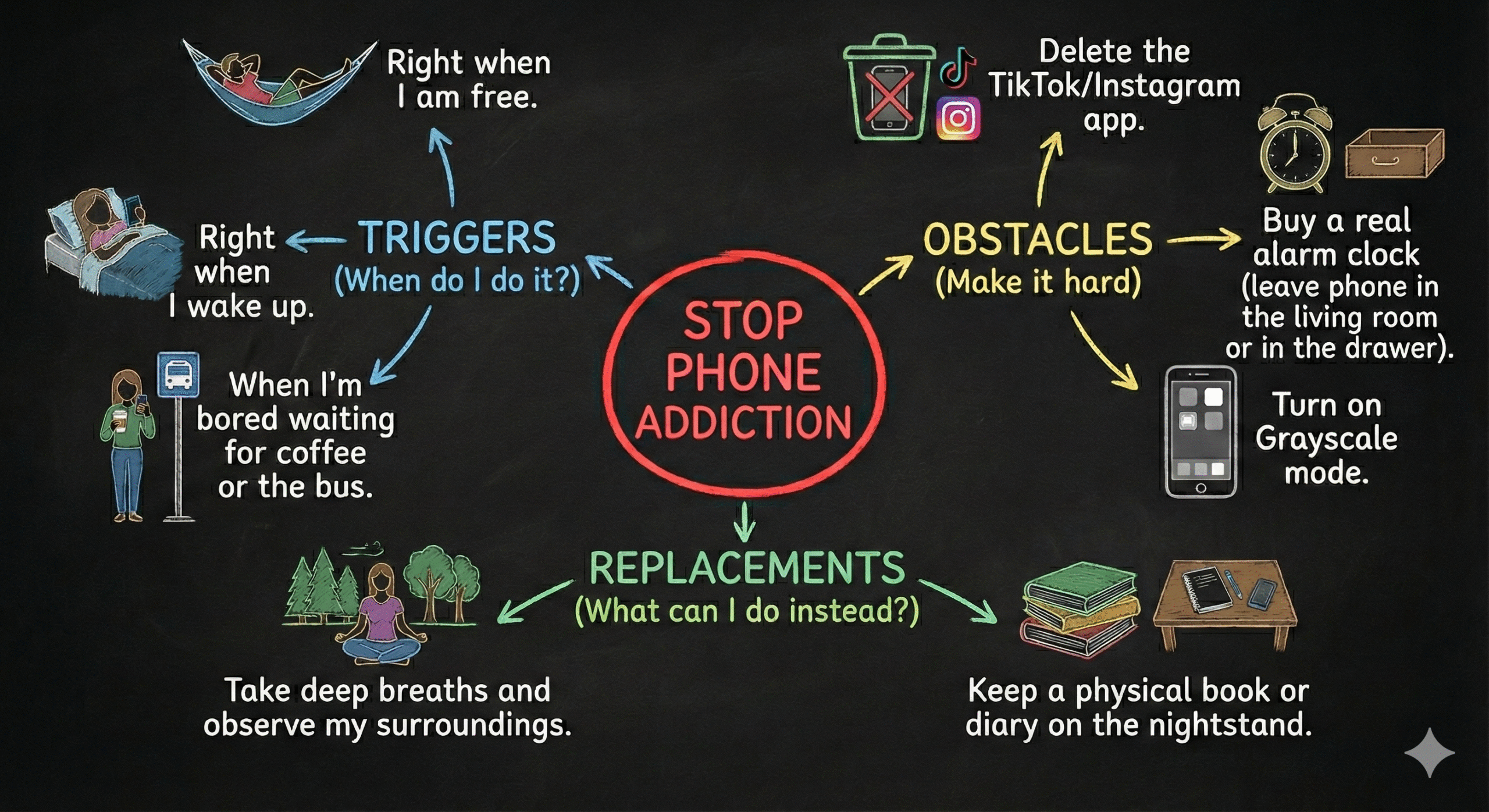
The Center would be: Stop Phone Addiction
-
Branch 1: Triggers (When do I do it?)
-
Twig: Right when I am free.
-
Twig: Right when I wake up
-
Twig: When I’m bored waiting for coffee or the bus.
-
-
Branch 2: Obstacles (Make it hard)
-
Twig: Delete the TikTok/Instagram app.
-
Twig: Buy a real alarm clock (leave phone in the living room or in the drawer).
-
Twig: Turn on Grayscale mode.
-
-
Branch 3: Replacements (What can I do instead?)
-
Twig: Take deep breaths and observe my surroundings.
-
Twig: Keep a physical book or diary on the nightstand.
-
Twig: Just stare at the wall or read.
-
Freelance Income Strategy
If you are applying for jobs on online platforms, a mind map is perfect for looking up where your money is actually coming from and where you are simply wasting time.
In such a scenario, mind mapping would look like:
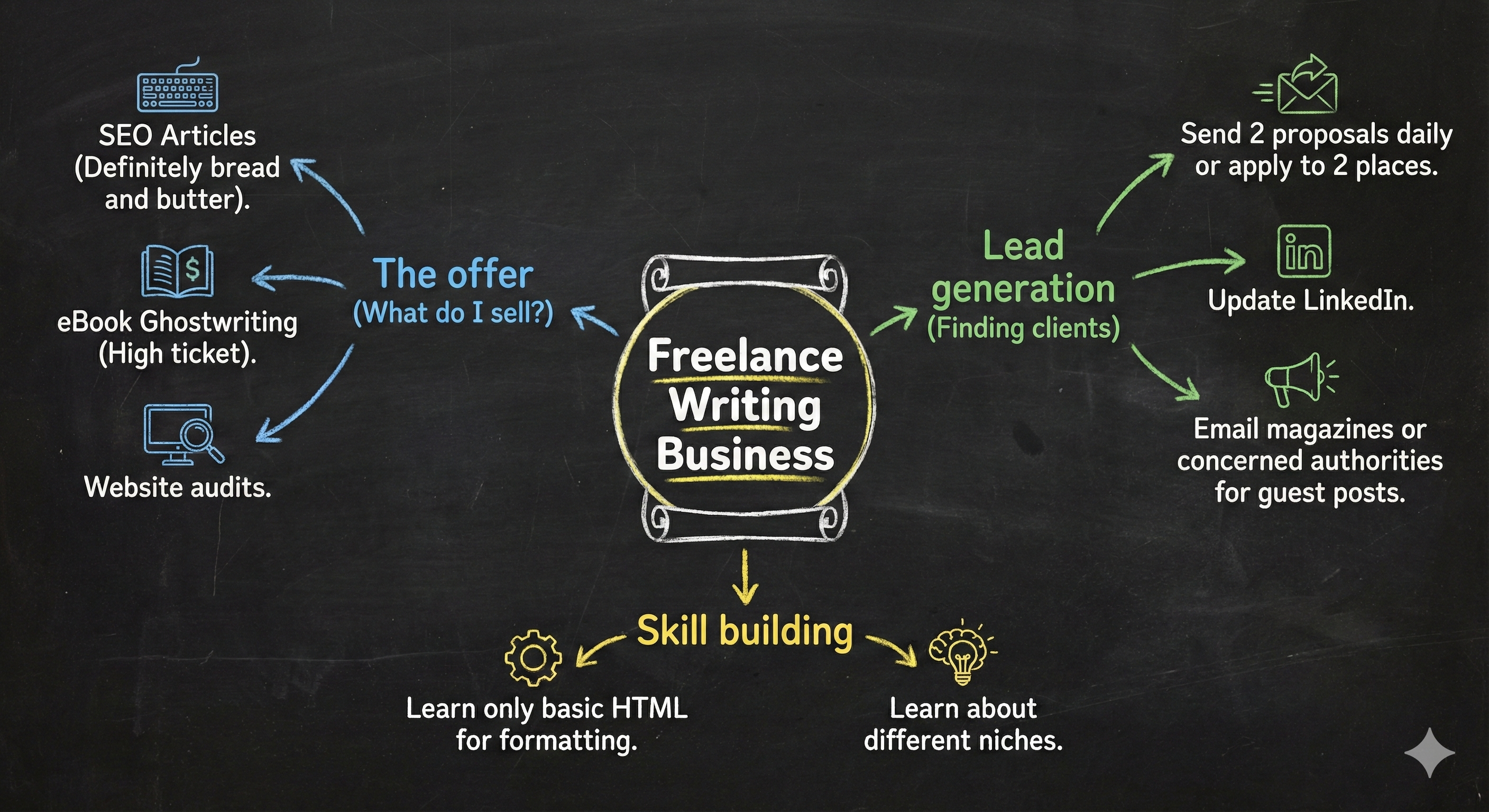
The Center would be: Freelance Writing Business
-
Branch 1: The offer (What do I sell?)
-
Twig: SEO Articles (Definitely bread and butter).
-
Twig: eBook Ghostwriting (High ticket).
-
Twig: Website audits.
-
-
Branch 2: Lead generation (Finding clients)
-
Twig: Send 2 proposals daily or apply to 2 places.
-
Twig: Update LinkedIn.
-
Twig: Email magazines or concerned authorities for guest posts.
-
-
Branch 3: Skill building
-
Twig: Learn only basic HTML for formatting.
-
Twig: Learn about different niches.
-
The Weekly Check-In
Using a mind map for relationships sounds clinical and strange, but it actually lowers emotion and helps you see the other person’s perspective clearly.
I personally found it effective for resolving conflicts or planning a future together.
In this case, mind mapping would look like this:
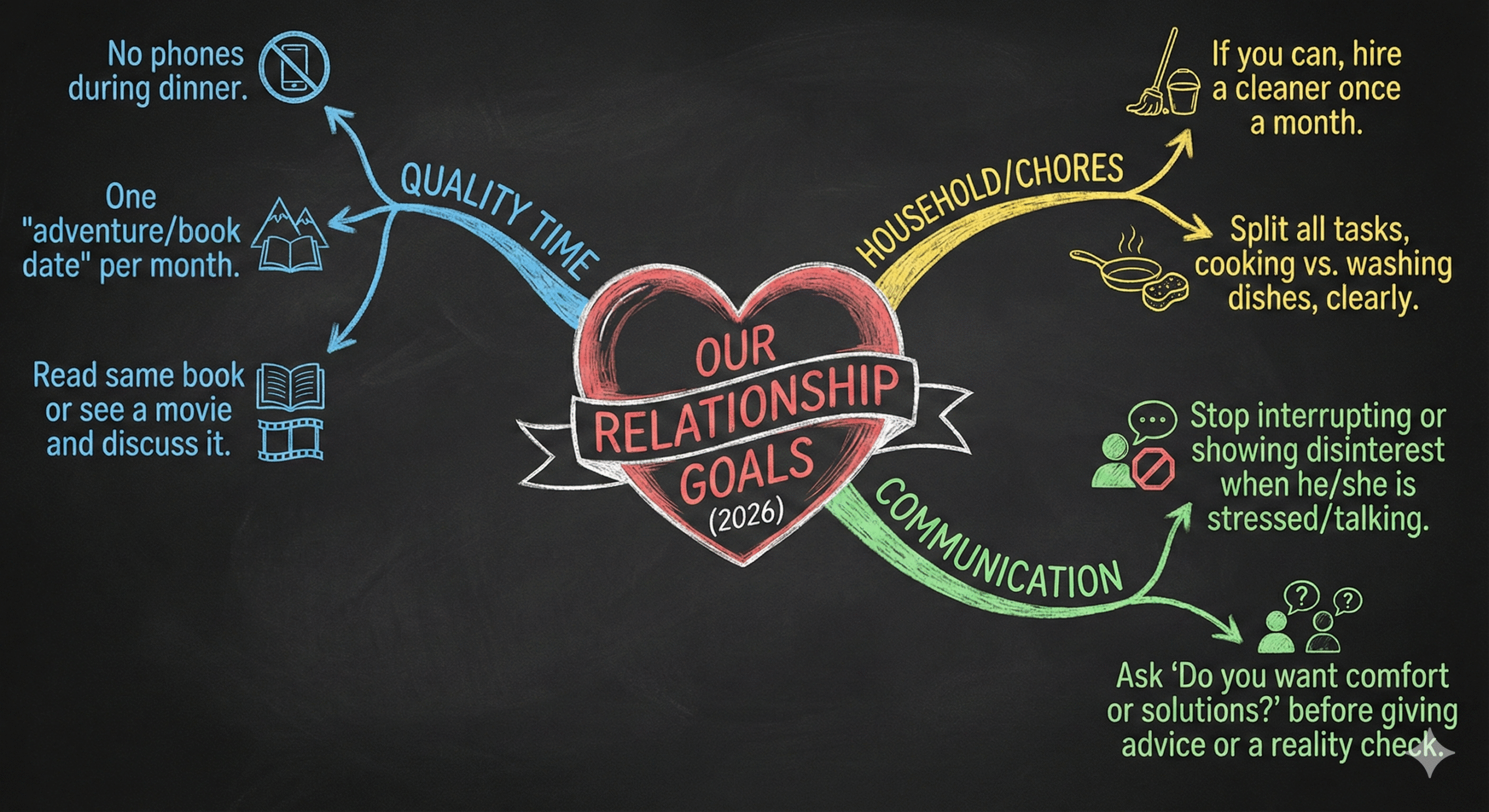
The Center would be: Our Relationship Goals (2026)
- Branch 1: Quality time
- Twig: No phones during dinner.
- Twig: One “adventure/book date” per month.
- Twig: Read the same book or see a movie and discuss it.
- Branch 2: Household/Chores
- Twig: If you can, hire a cleaner once a month.
- Twig: Split all tasks, cooking vs. washing dishes, clearly.
- Branch 3: Communication
- Twig: Stop interrupting or showing disinterest when your partner is stressed/talking.
- Twig: Ask “Do you want comfort or solutions?” before giving advice or a reality check.
By now, you might have got a strong idea that mind mapping is useful. But let’s discuss clearly how it is good for you:
Why Mind Mapping is Better?
With the help of mind mapping, you can benefit by:
Boosting creativity: When you are thinking outside the box, the creative part of your brain gets stimulated through this exercise.
Improved memory: As mind mapping forms a visual representation of ideas or thoughts, you can visualize (see) a bigger picture of your project, idea, or solution. And as anything that is visualized gets stored easily, your memory is improved, and you stay focused on your goals.
Problem-solving skills: The art of mind mapping helps you find solutions to a problem by scanning out the connections and patterns easily.
Boosted productivity: You see your productivity enhanced through it as well. The map helps you finish your task easily and successfully, as you can break the larger parts into chunks.
It kills writer’s block: You don’t have to stress about the “order” of things. You can just dump ideas onto the page.

And trust me, I say this from experience, for I’ve used mind mapping in almost all sorts of situations in my life.
My Personal Experience
The correct answer is that I have applied mind mapping in various walks of life.
Let me begin with killing overthinking.
How?
Well, I begin with the thought that keeps on teasing me. Then I start drawing a map consisting of its origin, consequences, and solution.
Origin: What gives birth to this thought? Is it past experience? Is it just nervousness? Is it someone’s criticism?
Consequences: If this thought becomes reality, what would be the consequences? Are they small or large? Are they worth affecting my mind?
Solution: Can I stop this thought? If yes, how and when? Can I control the consequences?
This usually gives my brain a well-deserved break.
Likewise, I have applied it to my relationships, be they romantic or platonic. If I have hurt someone, I begin with a set of questions:
- Why did I do that?
- Did something trigger me?
- Did I react instead of actually listening?
- Did I do it to protect myself?
- If yes, was this the only way to speak my heart out?
- Do I need to apologize? (if yes, how)
- But what if I can’t apologize? Can I make up for it?
This takes me in a direction that I need to follow. And as my brain gets the direction, it frees me from unnecessary sadness, anxiety, and depression.
How Can You Be a Part of This Journey?
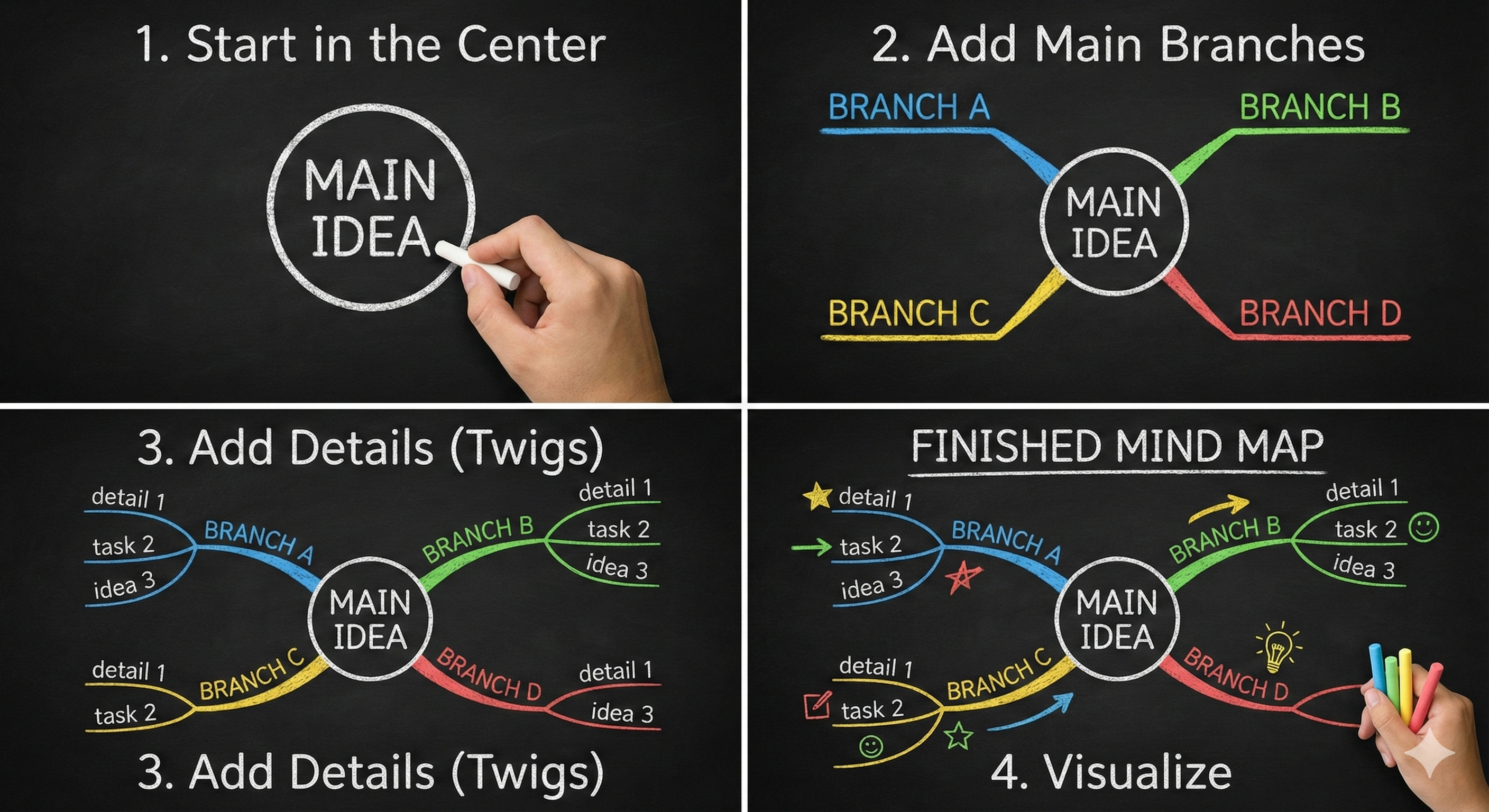
Well. Begin by focusing on one particular central idea and write it down in the center of a page or on any digital application. You can use an image or a word to represent your main idea. Now, connect your central idea with the related or sub-related topics. Each subtopic would be written down by drawing a line from the center towards the margins, just like branches spreading from one central point (root).
If there are sub-topics or sub-related ideas to those branches, you can add them in front of the front branches. Connect each idea with its sub-topic or related topic. You can utilize markers, highlighters, or colored pens to form a connection. Always use keywords, images, and symbols to showcase your ideas, for it makes visuals and visuals not only more memorable but also attractive.
Mind Mapping Tools
From a simple pen to multiple digital applications, you can craft a mind map quite easily. But if you love to use technology, the most popular and used online mind-mapping tools are Coggle, XMind, and MindMeister. You can use any of them to decide which one better suits you according to your needs and taste.
To quickly become the master of mind mapping, follow these tips:
- Keep your map or tree simple and plain. The cluttering of ideas will only confuse you.
- Use colors, symbols, images, or highlighters to make your map visually appealing and more memorable.
- Experiment with different formats of mapping to know which one suits you the best.
15 Best Mind Mapping Ideas
You can use these 15 Best Mind Mapping Ideas to begin with:
-
Weekly meal plan: Map out a meal plan (breakfast, lunch, dinner, and snacks) for the whole week.
-
Vacation planning: Branches for budget, destination, packing list, and itinerary.
-
Book summary: Break down the book by plot, characters, and key quotes.
-
Goal setting: Set yearly goals for your health, finances, career, and relationships.
-
Meeting notes: Track the agenda, key points, and action items in real-time.
-
Problem solving: Put the problem (you are facing) in the center and branch out possible solutions and required resources.
-
Party planning: Organize the food menu, playlist, guest list, and decorations.
-
Language learning: Group new vocabulary by themes or meanings (e.g., travel, food, family).
-
Content creation: Brainstorm ideas for videos, blog posts, or social media updates.
-
House cleaning: Split tasks into everyday, weekly, and monthly tasks.
-
Project management: Outline milestones, deadlines, and team duties.
-
Gift ideas: Create branches for each person (with their names) and list potential gifts based on their interests.
-
Decision making: Map out the “Pros” and “Cons” of a giant choice (like changing or moving jobs).
-
Resume writing: Organize your education, skills, work experience, and achievements.
-
Daily routine: Structure your daily morning, work, evening, and bedtime habits.
Conclusion
In a nutshell, mind mapping is a useful technique that unleashes your creativity and boosts your productivity. By following the above tips regularly, you can become an expert in mapping and can multiply your productivity.