

Title: Gas Light (Angel Street)
Author: Patrick Hamilton
Narration: Third Person Narration
Language: English
Publication: 1938
Genre: Thriller
Writing Style: Simple
Major Characters: Jack Manningham, Belle, Inspector Rough
The Book Everyone Knows Without Knowing
Everyone has used the word “gaslighting.” Yet almost nobody knows where it actually came from.
Nowadays, Gaslighting shows up everywhere… in breakup texts, in therapy, in political discourses, in arguments about who said what at whose party. It would not be wrong to say that it has successfully become the go-to term for a very specific kind of psychological harm. And if you ask me…it is impressive, really, for a word that took a breath as the title of a 1938 Victorian thriller play that most people have never read.
The origin is this: a very manipulative husband, a wife who slowly starts believing that she is losing her mind, a flickering gas lamp, and… this is the part nobody mentions… a set of beautiful hidden rubies buried somewhere in the walls of a London’s ancient mansion.
Yet the story of its origin, odd as it is, is only half of what is interesting here. The main question is why gaslighting works the way it does. Not just as a lie or a tactic, but as a direct attack on identity itself. To understand that, you need a French psychoanalyst called Jacques Lacan, his concept known as the “Mirror Stage,” and almost about six more minutes of your time.
Stay with me…
The Origin of Patrick Hamilton, Gas Light
Patrick Hamilton wrote a play named Angel Street in 1938. This play was later adapted into the 1944 Hollywood film Gaslight, and the film title is what stuck. The play is a three-act psychological thriller set in a Victorian London mansion in the Pimlico district. Almost all the action takes place inside the mansion, and almost nobody goes anywhere. The walls close in. Well.. that is rather the point.
Our two main characters are Jack Manningham, the charming and quietly manipulative man, and a calculative lover. Then, we have his distressed wife, Belle. Things go missing in her presence, she hears noises from the sealed upper floor, and the gas lamps…the ones that light the house keep inexplicably dimming each night.
Every time Belle talks about any of this stuff, Jack blames her:
- She herself misplaced the things and then forgot.
- She is the one who can hear all noises.
- And the lamp? Well, she is clearly imagining it.
He goes on to belittle, humiliate, question her perception and memory, and concludes that just like her mother, she is going mad, just like her mother did. So, with the passage of time, Belle starts doubting her own memory. She begins to believe that the problem is her, not the lamp, misplaced things…or her loyal husband.
The truth, when it eventually arrives, is considerably very, very dramatic. Jack is not only a cheater and manipulator but also a murderer. Fifteen years earlier, he killed the previous resident of the mansion, a woman named Alice Barlow, to steal her wealthy collection of rubies. But even after killing her, he failed to find those precious rubies. So this time, he has returned with the same mission, married into the property, and has been conducting secret nighttime searches of the upper floor ever since. The lamps flicker because he is up there, burning gas each night. Belle notices well… because Belle is paying attention. Jack denies it because Jack needs her not to trust herself for obvious reasons.
Right here…this is gaslighting. Not just simply lying, but using someone’s perception against them.

What Gaslighting Actually Involves
Sociologist Paige Sweet has described gaslighting as a form of epistemic violence, an attack not on what a person actually knows, but on their ability to know things at all. It entails lying, confusion, isolation, denial, and sustained redirection of blame. Not as separate tactics but as a coordinated system.
As a result, the target believes they are insane or on the verge of becoming one.
In the play, observe Jack’s work. When a portrait goes missing, he does not accuse Belle quietly. He makes up the evidence by summoning his servants, conducting a public inquiry, and letting Belle’s humiliation do the rest. For example, when she mentions the theatre, he cancels the plan and blames her behavior. He says, “No, Madam, emphatically, I am not. You play fair by me, and I’ll play fair by you. But if we are going to be enemies, you and I, you will not prosper, believe me.”
He flirts openly with the maids in her wife’s presence. Nothing he does is accidental or natural. Every move is calculated and designed to chip away at one specific thing: Belle’s confidence in her own account of reality.
It is, as manipulation goes, genuinely sophisticated. Which is probably why Hamilton’s name for it has lasted this many decades.
Why It Works and Lacan’s Mirror Stage
Plenty of articles have been written about gaslighting, Patrick Hamilton (Gas Light), how it comes to the surface, and how to deal with it. It would not be wrong to say that most of them stop at “it’s bad and here’s how to spot it.” Fair enough. But the more interesting question, the one this article is actually about, is:
- Why it works.
- Why does it get inside identity itself, not just perception?
For that, we’ll need Lacan.
In the 1950s, French psychoanalyst Jacques Lacan suggested something (maybe) unsettling about how human identity works. His three orders: imaginary, symbolic, and real deal with “identification, specularity, narcissism, and aggression in the imaginary,” the unconscious, language, in the symbolic order, and its entrance into the real world. These three orders have been scrutinized to understand the formation of identity till now. The first imaginary stage occurs in early childhood ( between six and eighteen months) and plays a lion’s share in shaping how a child sees itself in relation to its image and others, especially children. In this stage, the child first encounters its reflection in a mirror, which Lacan famously calls the “mirror stage,” and it forms the basis of their self-perception.
What is relevant for us is mainly the “Mirror Stage,” and it goes like this.
Sometime between six and eighteen months old, an infant sees itself in a mirror for the first time. What it sees is a unified (gestalt), coordinated, and whole image of a person. This does not match the infant’s actual experience of its own body. His body lacks coordination and movement. In other words, it is quite fragmented, uncoordinated, and more importantly, not in control of anything. As the child can neither walk nor stand up, still at this stage, the child is fascinated by its image in the mirror, for it lacks nothing and has attained all bodily mastery and unity.
This, in turn, forces the child to run away from the perception of a fragmented body.
At this point, the infant does something remarkable. It starts to identify itself with the image that is both complete and perfect. It takes the reflection (the external and borrowed picture) as its real self. This identification gives birth to the ego. Note that the ego is born not from some authentic interior self, but from a misrecognition. It becomes a case of mistaken and false identity, with yourself as the suspect.
Lacan called this “meconnaissance” (misunderstanding). Misrecognition. And here is the part that is important for everything we are going to discuss: the mirror does not have to be a literal mirror or a looking glass. Other people act as mirrors, too. It means that the child relies on the external source for validation as well. As we grow, sometimes this habit stays, and we see ourselves reflected in how others look at us, speak to us, and respond to us. Which means that the people closest to us are not just observing our identity. They are always, to some degree, constructing it.
Jack Manningham as Belle’s Mirror in Patrick Hamilton (Gas Light)
Now, back to Patrick Hamilton (Gas Light)!
From the opening scenes of the play, Belle not only lives with Jack but also actually starts seeing herself through him. He becomes her mirror. And like the mirror in Lacan’s theory, what he reflects is not her real self but a fabricated one. The only difference between the infant and her is that Belle does not see a united or whole image. She perceives herself as a distorted personality who has lost their sanity and cannot distinguish between reality and illusion.
It is a carefully constructed identity, one that happens to be extremely useful to a man who needs her too destabilized to notice the gas lamps. He successfully projects an image of her as a forgetful, irrational, and mentally unstable lady. He says, “You unhappy wretch—you’re stark gibbering mad—like your wretched mother before you.” And she mistakes his projection for her own reflection.
She thinks that she is actually “mad.” And when the picture goes missing, Jack makes Belle believe that she must have taken the picture off the wall.
That is the Lacanian mechanism, running exactly as illustrated except that in Lacan’s version, the misrecognition is an innocent developmental stage. In Patrick Hamilton Gas Light, it is being engineered by someone to find rubies.
This is what makes gaslighting so much more dangerous than ordinary deception. A lie tells you something wrong about the world. Gaslighting suggests something false and entirely about yourself. And because identity is never fully self-generated and because it always leans somewhat on the mirrors we live inside, the lie has somewhere to land.

The Crack from The Mirror Stage
When your mirror is telling you that you are falling apart, you reach for any surface that reflects something different.
Lacan recognizes this, too: the child does not easily accept that it is incomplete. The instinct to defend the self-image is strong, even when the mirror projecting the distortion is the person you share a house with. What is remarkable about Belle’s response to this is that she also pushes back consistently. She does not believe that her reflection or image is fragmented and incomplete. She keeps on insisting that she is not crazy.
And it is not because she has proof, but because something in her constantly opposes the distorted image.
Moreover, her behavior around the young maidservant, Nancy, (whom Jack openly favors), is telling. She is not being petty. She is holding on.
For instance, when Nancy comes to serve tea in Act One, Belle tells her that she and her husband are going to see the theatre soon. She does so to maintain a superior and whole sense of perfect identity over herself. She tells her, “I daresay you’re right. I must bear it in mind. Mr. Manningham’s taking me next week, you see.”
She also tells her husband that she does not like Nancy much, as Nancy “thinks me a poor thing. And now she can suffer the news that you’re taking me to the theatre.”
The Break, Inspector Rough, and the Return to Reality
In Patrick Hamilton (Gas Light), the twist arrives in Act Two. Inspector Rough, a retired detective who has been secretly, quietly watching this household for years, visits Belle while Jack is out. He tells her everything:
Her husband is a murderer. “You see, I am afraid you are married to a tolerably dangerous gentleman.”
The noises from upstairs are real.
The dimming lamps are real.
None of it is in her head.
In Lacanian terms, this is a rupture point. The mirror has shattered. Belle is not being given new information about Jack. Instead, she is being given herself back. The self that Jack’s constructed image had slowly almost displaced.
Her response is amazing, and at this point, it offers a decisive moment where “it produces the future through anticipation and the past through retroaction.”
When Rough apologizes for the terrible nature of his revelations, Belle announces her happiness:
“The most horrible? Oh, no — the most wonderful. Far and away the most wonderful.”
Those lines are doing a lot of work. The horror of learning that you married a murderer is very real. But it is smaller than the relief and joy of learning that you are not crazy or insane. That the lamps really did flicker. That your perception was accurate and complete all along. That you were not the problem to be solved.
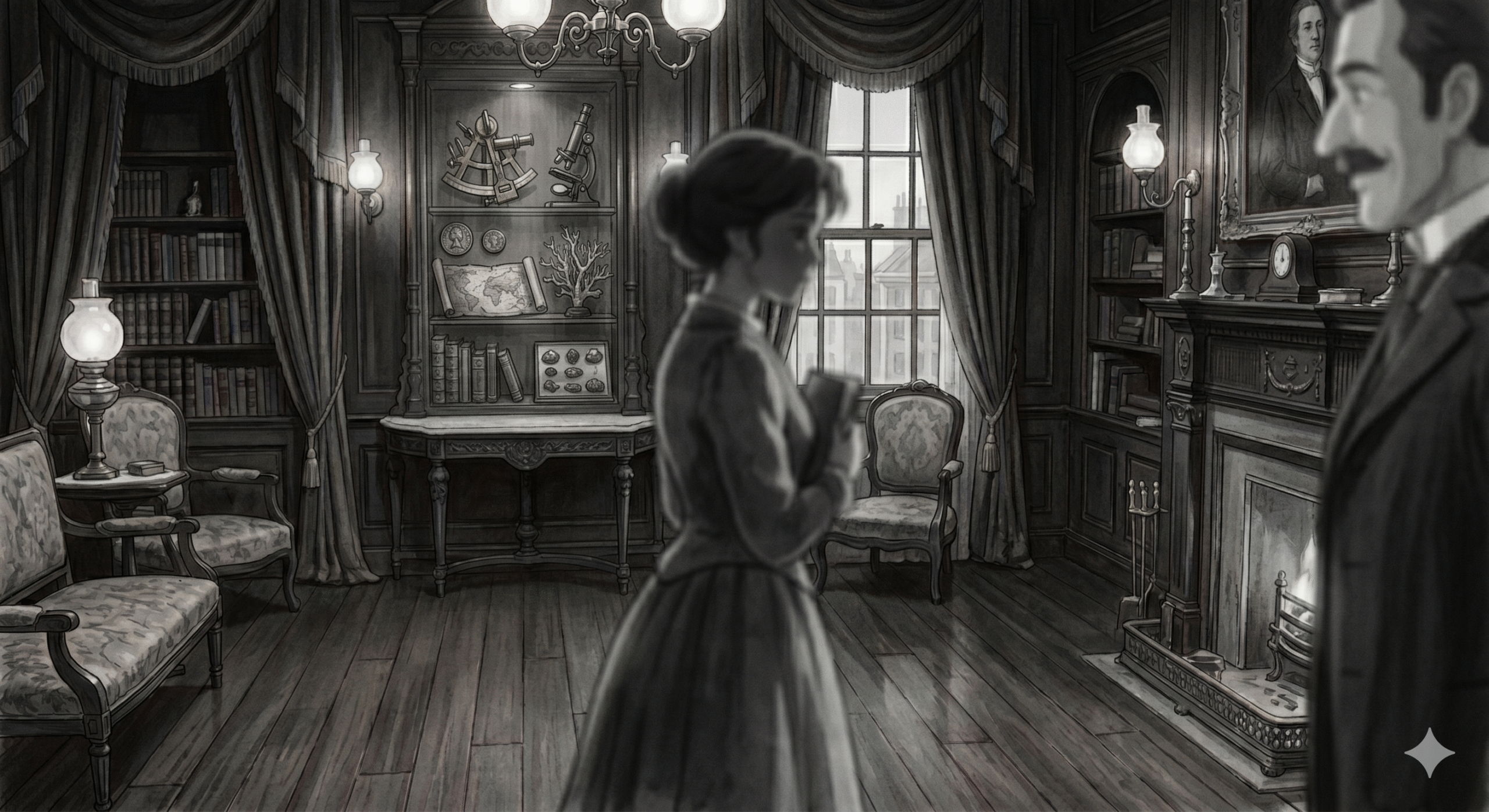
Bella’s final confrontation with Jack is also an important moment in the play that represents the break from the Mirror Stage. She starts asserting her own independence and autonomy, questioning Jack’s false accusations, and standing up for herself. She uses his own words against him, “And I am trying to help you, aren’t I ?—to help you escape— But how can a mad woman help her husband to escape? What a pity—”
All in all, Patrick Hamilton Gas Light was not a play about the theory of identity. It was only a thriller play about a man hunting rubies. But that is rather the trick of great world literature: it tells you a smaller story of ordinary people while accidentally demonstrating a much larger one, and leaves the rest of us to catch up a century later…one mirror at a time.
Works Cited
Gallop, Jane. “Lacan’s ‘Mirror Stage’: Where to Begin.” SubStance, vol. 11/12, no. 37-38, 1982, pp. 118–28, https://doi.org/10.2307/3684185.
Hamilton, Patrick. Angel Street: A Victorian Thriller in Three Acts. Samuel French, 1942.
Lacan, Jacques. Ecritis. mudrac.ffzg.hr/~bmikulic/Filoz-Psy2012/JL_0393329259.pdf.
Leo, Jeffrey R. Di. Contemporary Literary and Cultural Theory. Bloomsbury Publishing, 2023.
Payne, Michael, et al. A Dictionary of Cultural and Critical Theory, Second Edition. seminar580.wordpress.com/wp-content/uploads/2015/04/dictionary-of-cultural-and-criticaltheory.pdf.
Sweet, Paige L. “The sociology of gaslighting.” American Sociological Review 84.5 (2019): 851-875.